
Leadership Now’s Corporate Guide to Navigating U.S. Political Risk
Corporate Guide to Navigating U.S. Political Risk
Key Priorities and Action Steps for Boards, Management Teams, and Investors.
Get startedThis guide provides strategies for corporate boards, management, and institutional investors to navigate U.S. political risks and activities, outlining key priorities and best practices for each.




Section 01
Introduction: U.S. Political Risk is No Longer the Exception
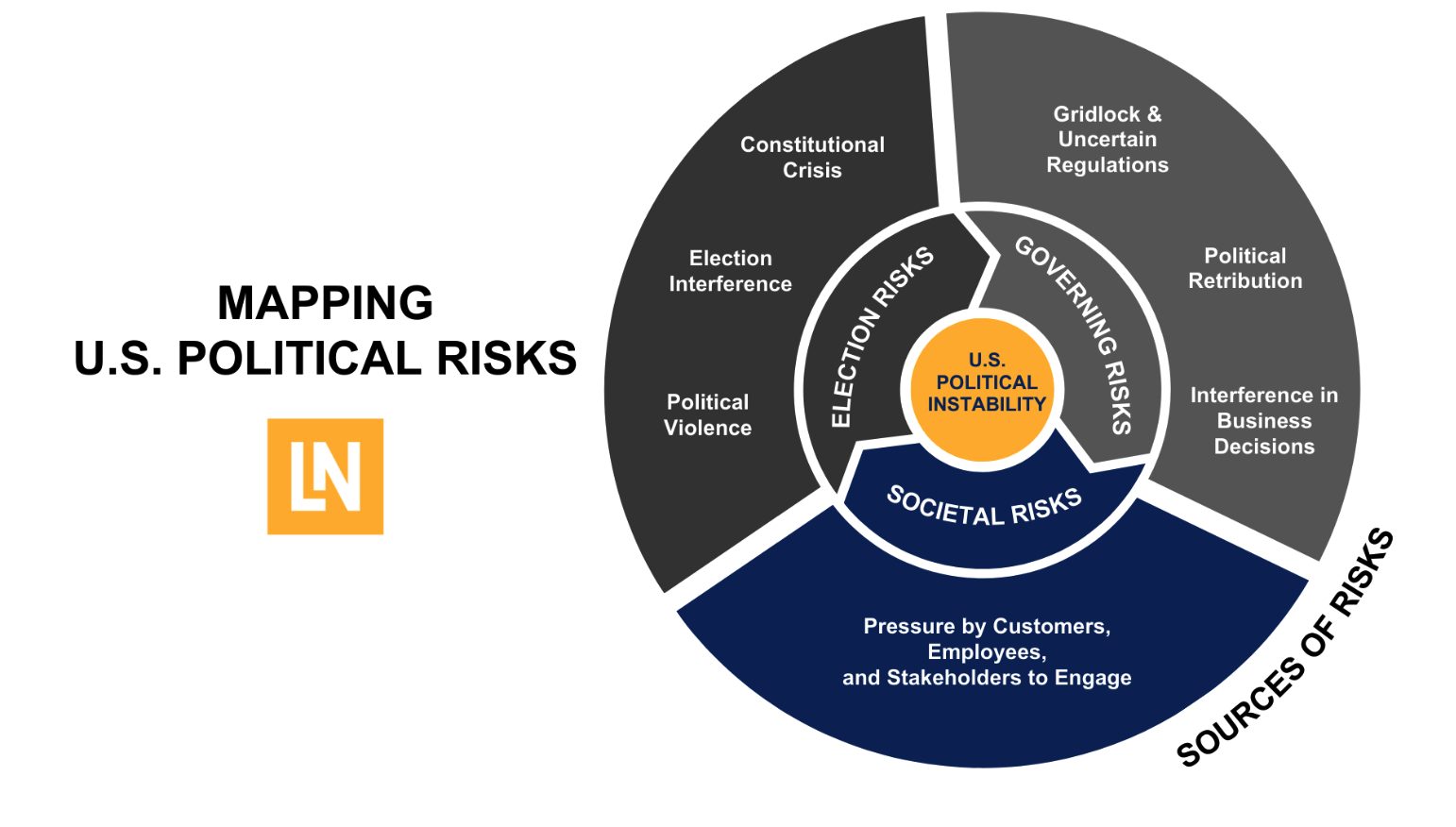
Preparing for the impact of U.S. political risk is now a basic requirement of every company’s risk management process.
Increasingly, companies are under tremendous pressure from employees, customers, shareholders, and regulators to engage on a much wider range of issues than ever before. And institutional investors are under pressure to determine the impact of this engagement on the risk/return profile of their portfolios. However, decisions about corporate political activities and engagement are not always straightforward.
In the current climate, having a clear process for managing political activities is just part of basic risk management for every company. Having a robust process in place for making decisions about political activities is key to decreasing risk both to individual companies and the U.S. financial markets, and to restoring U.S. political stability.
Corporate boards’ oversight of risk management requires oversight of how the company manages its U.S. political activities. Currently, only 25% of corporate boards consider political risk when making board decisions.
With elections already underway, it is a particularly important time for companies to evaluate how they manage their political activities, and ensure those activities support strong and well-functioning political institutions.
Preparing for the impact of U.S. political risk has become a basic requirement of every company’s risk management process.
The Pressure Is Real
- 89% of surveyed U.S. executives identify polarization/extremism as a threat to the business climate, according to a survey by the Conference Board.
- CEOs ranked geopolitics and political uncertainty as the top risks to growth over the next 3 years (up from #7 in 2022), according to the KPMG 2023 CEO Outlook.
Companies Face Conflicting Stakeholder Expectations
- Investors believe the top priority for companies in 2024 should be attracting and retaining employees, and are increasing engagement with companies about the board’s handling of material issues, according to an EY Center on Board Matters report.
- However, less than half of workers are satisfied with how their employers are handling various social issues, according to a recent Conference Board report.
- Consumers are also split on which topics companies should engage on and how, with differences across age groups, political backgrounds, and other demographics, according to a Gallup survey.
Business Faces the Risk of Political Retribution
- 68% of U.S. business executives surveyed by the Conference Board fear retribution from federal elected officials over the next 3–5 years. Companies from Delta to Disney to Chick-fil-A have been subject to political retribution for expressing opinions differing from political leaders.
Executive Presentation
For a more detailed analysis of the risk landscape, see our executive presentation, Understanding U.S. Political Risk: Implications for Business.
“[W]e operate with a very important silent partner — the U.S. government — … as my friend Warren Buffett points out that his company’s success is predicated upon the extraordinary conditions our country creates.”— Jamie Dimon, JP Morgan CEO ↗
Section 02
How to Use this Guide
Tools and best practices organized by user: Boards, Management Teams, and Institutional Investors.
This guide establishes a framework for connecting U.S. political risk to specific business risks, and provides tools and best practices for navigating those risks. The tools are divided into three sections according to the user: Board Oversight Checklist; For Management Teams: Step-by-Step Actions; and Institutional Investor Checklist. Each section outlines key priorities and suggested actions, includes examples of how companies have implemented these suggestions, and offers links to resources that may be helpful.
-
Boards
Corporate boards’ oversight of risk management should include how the company manages its U.S. political activities. Currently, only 25% of corporate boards consider political risk in their decisionmaking. The “Board Oversight Checklist” section of this guide offers a checklist for boards to review their oversight of U.S. political risk and outlines key questions they should be able to answer. It serves as a roadmap for the information boards should request from management for effective oversight and identifies the types of political activity decisions that should be escalated to the board level.
-
Company Management
U.S. political risk can impact almost all functions of a company. The guide outlines five key steps that company management can take to manage U.S. political risk effectively, along with the best practices that boards expect to be implemented. While the impact of political risks may vary based on a company’s industry, geography, and strategy, all companies need a proactive process to manage these risks.
-
Institutional Investors
Similar to the companies in which they invest, institutional investors now need to integrate U.S. political risk into their risk management processes as well. The sixth section of the guide provides questions that investors can use to engage with their investment managers and portfolio companies about U.S. political risk, manage their own alignment/misalignment considerations, and evaluate oversight of U.S. political risk.
Section 03
U.S. Political Risk Framework
Translating U.S. political risk into business risks that companies can act on.
U.S. political risk can impact all facets of a company, including operations, customer and investor relations, talent management, communications, and more. The way political risks impact companies may vary based on the industry, geography, and strategy of the company, but all companies need a process to proactively map these risks and implement steps to mitigate them. Our U.S. political risk framework is designed to help companies identify the specific risks to which they are exposed and understand how those risks will impact particular functions within the company.
Our framework divides the risks created by U.S. political instability into three categories — Rule of Law & National Security, Operating & Economic, and Societal & Institutional — and maps how those risks translate into specific business risks across corporate teams.
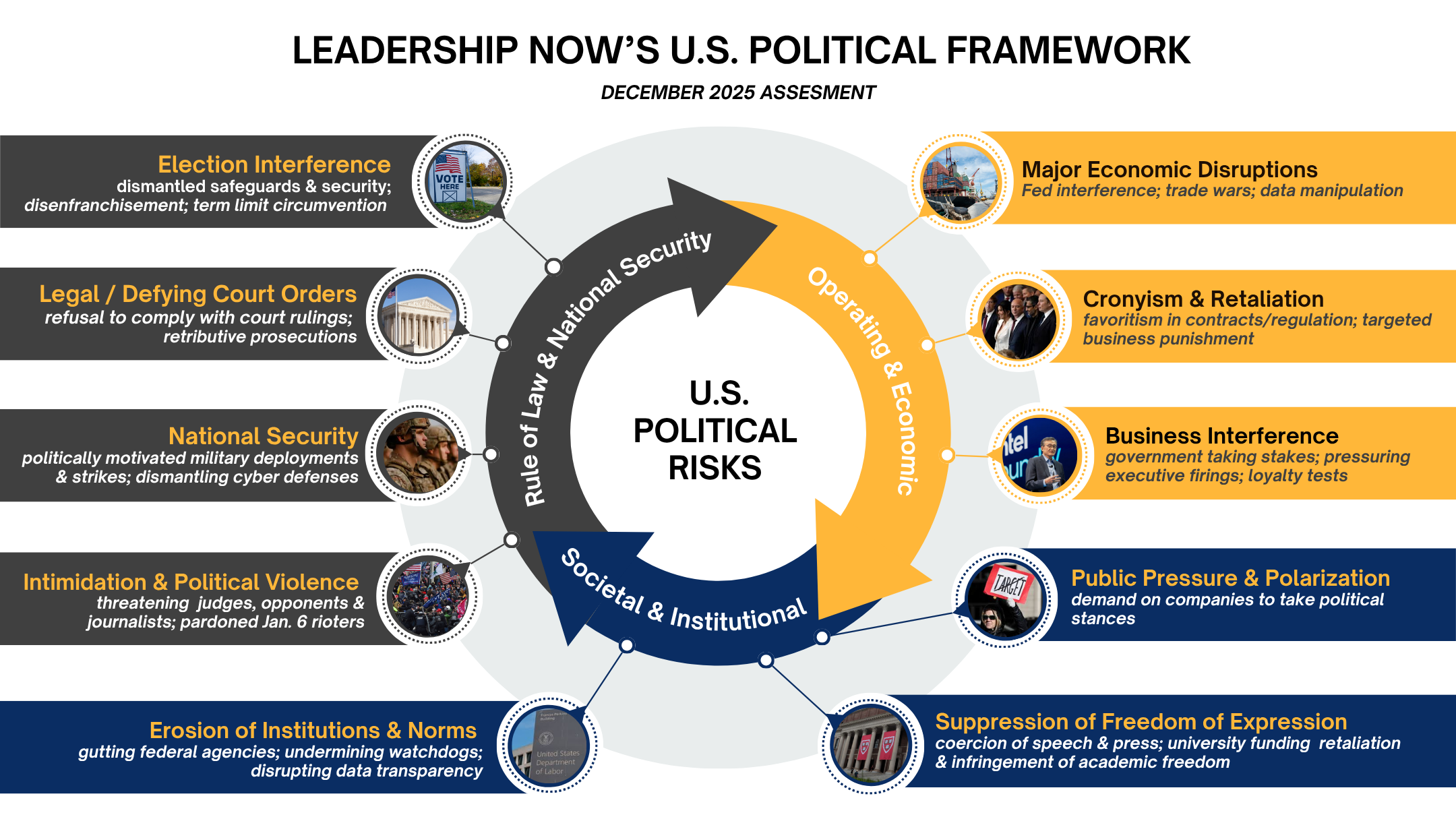
Election Interference · Legal / Defying Court Orders · National Security · Intimidation & Political Violence · Erosion of Institutions & Norms
Major Economic Disruptions · Cronyism & Retaliation · Business Interference
Public Pressure & Polarization · Suppression of Freedom of Expression
U.S. political risks are expected to increase at both the federal and state levels. Use these questions to assess your company’s exposure across corporate functions.
| Corporate Team | Sample Questions to Identify Key Risks |
|---|---|
| Operations |
|
| Research & Development |
|
| Corporate Finance |
|
| Talent Recruitment & Management |
|
| Investor Relations |
|
| Customer Relations |
|
Section 04
Board Oversight Checklist
Boards of Directors have a fiduciary duty to provide oversight of how the company is navigating U.S. political risks.
Investors are increasingly focused on board effectiveness and are more actively engaging with boards about oversight of material risks, according to E&Y. At a minimum, effective oversight of U.S. political activities requires that Boards:
-
1. Define Company Political Activities
Boards should view political activities broadly to include lobbying, external statements or engagement on policy issues, and political spending (corporate PACs, direct and through third-party groups).
- What types of political activities does the company currently participate in and what is the goal of each type of political activity?
- How does the activity relate to company strategy?
-
2. Understand How the Company Manages Political Activities
Effective board oversight requires understanding not just what the company does, but how decisions are made, who owns them, and how information flows across the organization.
- Which management team is responsible? Are all relevant teams involved — Investor Relations, Talent Management, Operations, Risk, Legal, Government Affairs?
- What information is tracked and shared internally, and how frequently?
- How are decisions made and which require board approval?
- What are the top five political risks the company is exposed to this year?
- Does the company have a formal political activity policy? Is it publicly available?
- How does management stay informed about the political activities of trade associations to which the company belongs?
-
3. Specify Reporting Protocols
Determine the specific political activity data the Board needs to review and decide on the format of political activity reports to the Board, the management team responsible for compiling them, and establish a regular review schedule, such as quarterly.
- What data on U.S. political activities does the company track and which management team is responsible for tracking it? Does that data include shareholder engagement activity?
- What level of detail should the relevant board committee receive? What reporting should the full board receive?
- Which political activity decisions should require board approval? For example, cases of potential misalignment between company commitments and political activities should be reviewed by the board.
- What does the company report publicly about its political activities?
-
4. Select Appropriate Committee
Oversight of U.S. political activities can fit within the scope of multiple different board committees, including Risk, Audit, or Governance Committees. Some boards choose to create a specialized subcommittee (see examples below).
- Is there existing expertise on U.S. political risk within any existing board committees?
- Is there an existing committee that oversees complementary topics, such as geopolitical risk?
-
5. Enhance Committee Expertise
If necessary, provide committee members with training on the different types of political activities and the political spending landscape, including the role of third-party groups.
There are many ways to implement the above recommendations and each company and board will need to figure out what works best in their own context. Below are examples of some different approaches companies have taken:
Section 05
For Management Teams: Step-by-Step Actions
Five steps management teams can take to navigate U.S. political risk and be responsive to their Boards.
Conduct U.S. Political Risk Assessment
U.S. political risk can impact all facets of a company: operations, customers, employees, and shareholders. How political risks impact companies may vary based on the industry, geography, and strategy of a company, but all companies need a process to proactively map these risks and put in place steps to mitigate them.
To conduct a political risk assessment, management should:
- Identify U.S. Political Risks Annually. Some helpful questions to ask are:
- What are the key political risks affecting company strategy? Consider geographies where the company has employees, customers, operations or supply chain exposure. It may also be helpful to consider a company’s specific customer base (for example, is your customer base majority women, baby boomers, millennials, etc.)?
- What issues is the company hearing about most from employees, customers and shareholders?
- What is the risk of not speaking out on issues identified above (reputation; stakeholder relations; longer-term systemic risks that will impact operations)?
- What are peer companies doing on relevant issues?
- Consider Time-Specific Factors: It may be helpful to map risks according to key time periods like election cycles, voting days, and ballot counting.
- Establish Company Policy Priorities: Determine and agree upon the company’s policy priorities. These may include key areas that affect operations as well as company commitments related to sustainability, ESG, diversity, inclusion, and other areas. For example, Honeywell Policy Priorities and Alphabet Policy Priorities.
- Map Risks Against Policy Priorities: Identify issues where U.S. political risk overlaps with policy priorities and prioritize areas for political activity engagement. Ensure that all relevant internal teams have access to the information and input into the prioritization.
- Integrate into ERM Framework: Incorporate this mapping into an Enterprise Risk Management (ERM) Framework, adapting it as necessary for your company’s context.
| Risk | Score | ↕ |
|---|---|---|
| Regulation | Moderate | ↑ |
| Geopolitical | High | ↑ |
| Business Disruption | Moderate | ↓ |
| Employee Relations | High | ↑ |
| Growth & Investment | Low | ↓ |
| Department | Consulted | Rating |
|---|---|---|
| Sustainability | 12/31/23 | 3.1 |
| Govt Affairs | 1/15/24 | 2.5 |
| Operations | 12/15/23 | 1.4 |
| Legal/Compliance | 1/15/24 | 1.8 |
Sample dashboard showing key types of information included and who can access.
Understand The Data
It is impossible to know where you are going if you don’t know where you are.
The first step is to gain an understanding of your company’s current political activities. Political activities include lobbying, external statements or engagement on policy issues, and political spending. If you do not already have the information readily available, you can take the following steps:
- Perform an Internal Audit: Conduct an internal audit of the past year’s political activities, focusing on policy positions the company has taken, public statements on policy issues, and political spending (including lobbying and election-related spending).
Tip on Political Spending To get a meaningful picture of a company’s political spending means including election spending done through company PACs as well as directly from the company, and lobbying spending. It is also important to look through the third-party groups to whom a company gives. If industry or other third-party group recipients do not already disclose political spending, companies may want to require this information as a condition of membership. Review the Center for Political Accountability’s report: Practical Stake: Corporations, Political Spending, and Democracy for more.
- Share Data Across Relevant Teams: Ensure that all relevant internal teams have access to the data and a process for reviewing it regularly. These teams may include Operations, Risk, Government Affairs, Talent Management, Sustainability, Communications, Investor Relations, and Legal/Compliance.
Decisionmaking Framework
Establish a comprehensive approach to decisionmaking about political activities, focusing on setting non-negotiable standards, analyzing benefits and costs, and deciding when to engage.
- Include Key Internal Stakeholders: Identify all internal departments that affect or are affected by decisions about political activities and make sure a representative from each department provides input. This will typically include the Risk, Operations, Sustainability, Government Affairs, Communications, Investor Relations, and Legal/Compliance teams.
- Identify Red Lines: Determine if the company has non-negotiable criteria or “red lines” related to political activities. Examples could include a candidate’s support for political violence or legislation that threatens access to voting. Scenario planning ahead of time and making decisions about extreme events make it easier to react thoughtfully if and when these events occur.
- Adopt Rules for Decisionmaking about Political Activities: Establish clear rules and a set of criteria for how management will evaluate and balance competing considerations regarding specific political activities. A clear decisionmaking framework can help guide decisions when company priorities conflict. For instance, when a legislator supports one policy that is critical to the company’s operations but also supports legislation that conflicts with corporate sustainability commitments, or weakens voter protections. Having a decisionmaking framework in place ahead of when decisions are needed, using it consistently, and communicating transparently about the decisions, can decrease the risk of pushback from stakeholders.
- Assess Engagement Policy: Determine if and when to engage with policymakers, especially recipients of political spending, when positions conflict with company priorities. Evaluate the risk of failing to engage on relevant issues as well. For example, if an industry association supports a candidate or organization that works counter to your company’s corporate commitments, a company can choose to no longer be a member, or engage with the group to try to apply pressure to change practices. This is something a company can do with peers.
Communicate Transparently & Engage Strategically with Shareholders
For effective public communication and shareholder engagement, we recommend the following approach:
- Determine Reporting Frequency: Decide on the regularity of public reporting on political activities (annually, quarterly, etc.). Consider timing for other public reports the company may already issue, such as Sustainability reports, and determine whether to combine.
- Key Reporting Elements: The company’s political activity policy should be publicly available on its website, and should cover how the company determines policy priorities, the governance of those decisions, and how it determines when to engage in policy matters (its decisionmaking framework). Public reporting should also include detailed information on political spending and shareholder engagement.
- Make Sure to Include Third-Party Spending: Look through recipients that are third-party organizations to understand what portion of your company’s funds are going to which causes and candidates.
- Address Misalignments: Clearly communicate any conflicts between political activities and corporate objectives/commitments, and explain the decision to either maintain the misalignment or the steps being taken to address the misalignment.
- Review Shareholder Engagement: As companies see a broader range of issues being raised through shareholder proposals, consider shareholder engagement practices not just around proxy season, but during the off-season as well. Ongoing communication with investors can help companies stay ahead of investor concerns and negotiate ways to be responsive.
Mitigate Impact of U.S. Political Risk
Mitigation can be done by forming coalitions, aligning contributions, backing non-partisan groups, and depolarizing discussions.
- Join Coalitions: You don’t have to go it alone — build and join coalitions across industries. That strengthens the message about the risks posed by weakening rule of law in the U.S., and makes clear that the issue cuts across any special interests.
- Support Non-Partisan Organizations: Many groups are actively working to mitigate the risk of political instability in the U.S., particularly by supporting election integrity and security, and by dedicating efforts to increase voter registration and turnout. These investments are crucial for maintaining public trust in the electoral system and ensuring fair and secure elections.
- Focus on the Facts: Disinformation and misinformation are two of the most cited risks heading into the 2024 election. Make trusted resources about election information and civic engagement available to employees.
- Depolarize Employees: Provide resources for ways to talk through thorny issues of disagreement and model the same in how the company addresses such issues.
- Support Employee Voting: Provide paid time off for employees to vote and work at the polls (see Corporate Civic Engagement Checklist).
Section 06
Institutional Investor Checklist
Investors should consider exposure to U.S. political risk and steps to mitigate it.
Below are actions that investors may want to consider when evaluating U.S. political risk:
-
Engage with Companies
At a minimum, an investor’s due diligence process should include questions about how its investment managers and the companies in which it invests think about and manage U.S. political risk.
Key Questions to Companies:
- Does the company have a political activity policy?
- Does the Board have oversight of political activities? Which activities require board approval? How often does the board review political activities?
- How does the company think about misalignment between its political activities and its other corporate priorities?
- What information and how often does the company report political activity information to investors?
- Has the company been subject to proxy proposals related to political activities and what was the response?
Compare to Best Practices:
- Evaluate the answers against the best practices outlined in this guide and if there are gaps, ask the companies to explain what they are doing to address those gaps.
- Investors can share this guide with its investee companies and investment manager partners.
-
Consider Investment Misalignment
- If an investor has made any commitments as part of its investment policies, for example, to integrate ESG factors, it is important to review the political activities of its investments and identify any areas that may conflict with the goals in its investment policy.
- If there are conflicts, decide whether to engage with investee companies to try to influence them to change practices, or whether to reallocate its investments.
-
Evaluate Oversight of U.S. Political Risk
- As an institutional investor, many of the best practices outlined for companies in this guide apply equally to investors and investment committees. Review governance and oversight practices against best practices in this guide.
- Perform portfolio-level analysis. U.S. political risk may impact investors’ portfolios, either directly or indirectly. Whether an investor manages assets internally or through an investment manager, it should ensure that, in addition to company-specific analysis, portfolio-level stress testing against political risks are being conducted.
Defend. Build.
Leadership Now Project works with business leaders to protect the institutions that make long-term growth possible. Join the coalition.
Learn More About Membership Protect Our Elections