Leadership Now’s Rising Generation: “People Are Tired of Being Talked At”
At the Leadership Now Summit, rising political leaders made the case that Americans are hungry for pragmatism, patriotism, and real results.
One of the Leadership Now Summit’s most optimistic and revealing conversations focused on the question of who comes next.
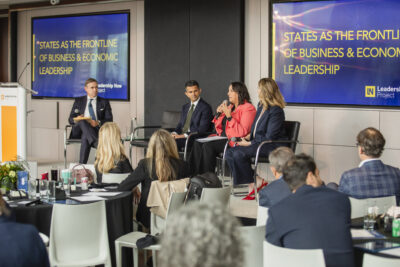
Moderated by Jessica Tarlov, co-host of Fox Five and Raging Moderates, the “Next Generation of Leadership” panel brought together Cait Conley, Mayor Phillip Jones, Congressman Pat Ryan and Iowa State Auditor and gubernatorial candidate Rob Sand for a conversation about what voters are looking for.
Tarlov opened with a revealing statistic about America’s leadership gap.
“Forty-five percent of our federal lawmakers are over 60,” she said. “In other Western democracies, it’s only 10 to 20%.”
But panelists made clear that the issue extends beyond age. The deeper challenge, they argued, is whether leaders are equipped to understand the country’s economic and cultural anxieties.
Congressman Ryan said that younger leaders must reconnect politics to service and national purpose.
“We love this country,” Ryan said. “We are rooting for this country to succeed. We are patriots.”
In part, that means putting common interest above partisan wrangling.
Mayor Jones, one of the most closely watched young mayors in the country, described local leadership as inherently collaborative. He emphasized that people ultimately care less about partisan identity than whether government can actually deliver.
Auditor Sand said that many Americans increasingly feel politically homeless. He described Iowa voters as deeply skeptical of political brands and more responsive to authenticity and accountability.
Conley, who previously served in national security roles, focused on rebuilding trust with communities that Washington too often overlooks. She argued that leaders must engage voters directly and honestly on economic opportunity, institutional trust, and what government can realistically achieve.
That means approaching the job with a greater degree of openness — and embracing a wider breadth of experience.
“We want our country to do better,” Tarlov told the audience of business executives. “Part of that means having people in positions of power who are not only bringing a new perspective because they’re from a younger generation, but different kinds of expertise, experiences, just an outlook on life and the way the country should go.”
After the panel, author Oliver Libby took the stage to present new polling and messaging research on economic mobility. His presentation centered on a practical question: how should Democrats and centrist leaders talk about economic opportunity in a way that resonates beyond ideological bubbles?

“What can we arm them to say?” Libby asked, referring to the next generation of leaders, “As a group, as a party, as centrists who are interested in practical messaging that would work?”
Finally, emcee Margaret Hoover sat down with Congresswoman Angie Craig, who reflected on winning a competitive rural district through a relentless focus on affordability, healthcare, and other kitchen-table challenges.

“Guess how much I talk about gay rights issues?” Craig — who is the first openly gay member of Minnesota’s congressional delegation — asked. “Negative.”
Craig argued that voters are less interested in politicians performing identity than in leaders who demonstrate competence, empathy, and results.
By the close of the conversation, the picture was clear: the next generation of political leaders is looking to move beyond exhausting partisan binaries and toward a politics of pragmatism, service, and trust.