Senator Elissa Slotkin’s Warning: “We Are Not Well”
At the Leadership Now Summit on May 11, the Michigan senator argued that America’s biggest threat isn’t overseas — it’s the shrinking middle class at home.
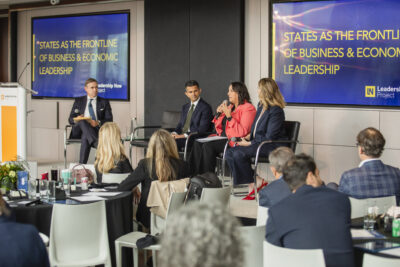
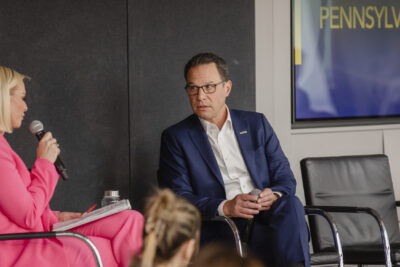
Speaking candidly before a room of business leaders at the Leadership Now Summit, Senator Elissa Slotkin delivered a stark assessment of America’s political and economic moment: the country’s deepest vulnerabilities are no longer primarily foreign threats, but domestic instability driven by economic anxiety and institutional distrust. In conversation with Leadership Now Senior Advisor Suzanne Nossel, Slotkin framed the current political era as a direct consequence of a shrinking middle class and a government many Americans no longer believe can deliver results.
“The existential threat to the United States right now is not coming from abroad,” Slotkin said. “It is the shrinking middle class in America. And if you want to understand why Trump is our president again, he is a symptom of that problem. He is not the problem.”
The senator, a former CIA officer and Pentagon official who won Michigan in one of the tightest races in the country, repeatedly returned to the connection between economic security and national security. She warned that decades of globalization left many Americans feeling abandoned, particularly in manufacturing communities across the Midwest.
“If you’re sitting in a small town in Michigan… you feel like you’ve gotten the a*s end of globalization,” Slotkin said. “You feel like you’ve lost out while others have gained.”
Throughout the discussion, Slotkin pushed for a more pragmatic, bipartisan approach to rebuilding public trust. She argued Democrats cannot simply promise a return to the pre-Trump status quo.
“We’re not going back,” she said. “We got Trump because the system we were a part of was not serving a majority of Americans.”
Instead, she called for a forward-looking agenda focused on advanced manufacturing, supply-chain resilience, AI competitiveness and tangible government action that improves daily life.
“People need to understand that government can still do things,” Slotkin said, arguing that leaders must focus on practical, bipartisan wins that restore confidence in institutions.
Her remarks also carried a warning about America’s standing globally. Reflecting on the dramatic swings in U.S. foreign policy across recent administrations, Slotkin said allies no longer trust American promises alone.
“The world is just not going to believe our words,” she said. “It’s going to be actions.”

Still, despite the gravity of her diagnosis, Slotkin argued there remains substantial room for bipartisan cooperation — particularly around manufacturing, technology, workforce development and economic competitiveness — if leaders stay focused on mission over ideology.
“We are ill right now as a country,” she said. “What do you do when a loved one is ill? You do everything you can to nurse them back to health.”